Author Archive

Palliative Care: A Supportive Option to Help Patients and Their Families

2024 May, Benefit Spotlight April 22, 2024

Navigating a serious illness can be challenging. Palliative care lessens the burden.

When you, or someone you care about, are diagnosed with a serious illness, it takes a massive toll on all aspects of your life. Navigating care options and figuring out your new normal can be overwhelming, and many are unsure how to find support — or if it’s even available. That’s where palliative care comes in.

Palliative care (which stems from the Latin word palliare, meaning “to cloak”) offers supportive care in many forms to lessen the burden and strain felt when you’re dealt a life-altering diagnosis. It acts as an additional layer of care to enhance your well-being alongside the current treatment plan that may already be underway.

Palliative care can be a good option if you are impacted by one of the following conditions: ALS, Alzheimer’s, cancer, chronic obstructive lung disease, heart disease, stroke, Parkinson’s, multiple sclerosis, AIDs, cystic fibrosis, and diseases of the kidney, liver, or lungs.

Palliative Care Differs from Hospice

Palliative care and hospice are not interchangeable terms. Hospice focuses on end-of-life care, whereas palliative care aims to improve a person’s quality of life and alleviate stress at any stage of an illness.

Unlike hospice care, palliative care does not signify an end of treatment or a terminal diagnosis — in fact, it is often done in tandem with curative treatment. Palliative care can help relieve issues such as breathing difficulties, pain, nausea, anxiety, loss of appetite, depression, constipation, fatigue, and lifestyle stressors.

Palliative Care is Needs-Based

Palliative care varies depending on the available resources in your area and your or your loved one’s condition. A palliative care team may consist of medical professionals and specialists—such as doctors and nurses — who help with symptom management, as well as social workers, chaplains, and financial advisors.

The demands on your mind, body, finances, and relationships may be overwhelming, but a palliative care team helps with weighing treatment options and better understanding your condition, empowering you to address important decisions surrounding:

  • Medical expenses: concerns around insurance coverage, Medicare plan, and financial planning for ongoing treatment
  • Living arrangements: a person can receive palliative care in their home, a clinic or hospital, a nursing home, or other setting
  • Legal documentation: setting up a power of attorney or creating a living will

Social support is another important component of palliative care. Because a serious illness can uproot your life, it often feels isolating. A palliative care team helps by connecting you with support groups, organizing and coordinating caregiving responsibilities, and seeking out community resources. Review your medical plan documents to see what palliative care options are covered by your plan.

Getting Started

There isn’t a set time when palliative care is offered, so you can seek out care early on (often once a diagnosis is received) to help plan for what is to come. The World Health Organization states, “early delivery of palliative care reduces unnecessary hospital admissions and the use of health services.”

Receiving care on your terms is of the utmost importance, and a palliative care team can communicate a patient’s preferences, goals, and wishes. Ask your provider for a referral, whether you are a candidate for palliative care, and what support resources are available to you.

Sources:

https://www.nhpco.org/
https://my.clevelandclinic.org/health/articles/22850-palliative-care
https://www.mayoclinic.org/tests-procedures/palliative-care/about/pac-20384637
https://www.nia.nih.gov/health/hospice-and-palliative-care/frequently-asked-questions-about-palliative-care
https://www.healthline.com/health/palliative-care
https://www.who.int/news-room/fact-sheets/detail/palliative-care

CPR Basics: A Lifesaving Technique

CPR, or cardiopulmonary resuscitation, is an incredibly critical technique that saves lives.

While many professions — from EMTs and childcare providers to flight attendants and swim instructors — require CPR certifications, understanding the basics of CPR is fairly simple and valuable to almost everyone.

When and Why Someone Could Need CPR

Cardiac arrest happens when the heart can’t pump blood, and it can occur in someone anywhere and anytime — even when you least expect it. When this happens, the heart cannot circulate blood to the brain and other vital organs.

The signs that someone may need CPR are they collapse, are unresponsive, stop breathing, and you cannot locate a pulse. Someone who is talking or showing breath movement does not need CPR (though they may still require some type of medical attention!).

CPR is instrumental in giving a person the best chance of survival while medical help is on the way. According to The American Heart Association, 350,000 people in the U.S. die from cardiac arrest outside a hospital each year, and immediate CPR can double or triple a person’s chance of survival.

The Steps of CPR

When effective, CPR can give someone without a pulse the ability to breathe on their own. Chest compressions are a key part of CPR because they help blood flow to vital organs.

A simple way to remember the steps of CPR is the acronym CAB, which stands for:

  • Compressions – Chest compressions
  • Airway – Open the airway
  • Breaths – Give rescue breaths

But the breakdown is a little more detailed:

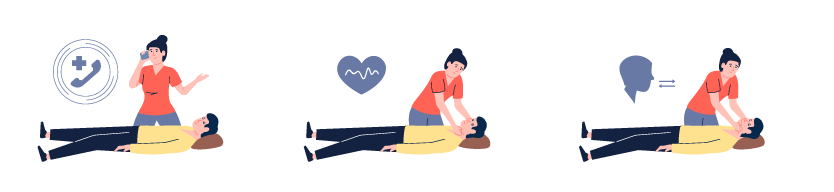
  • First, check the surrounding area to ensure it is safe for you to perform CPR.
  • Check the collapsed person for breathing or responsiveness. Try tapping them on the shoulder or shouting.
  • Call 911, mention cardiac arrest, and ask them to bring a defibrillator (commonly referred to as an AED). If someone else is around, ask them to do this while you being performing CPR.
  • If the person isn’t breathing, place them flat on their back on a firm, flat, and stable surface.
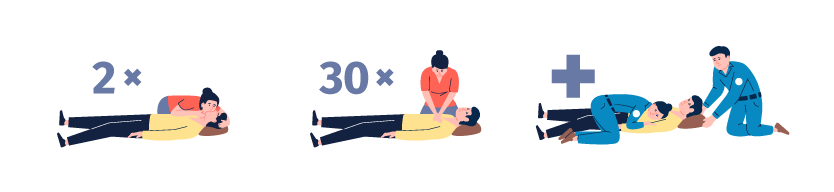
  • Place the heel of your dominant hand in the middle of the unresponsive person’s chest (imagine a line between the nipples), and then place your other hand on top. Deliver chest compressions using your weight and pushing down at least 2 inches deep at 100–120 compressions a minute. A common tip is to try and match the musical beat of Stayin’ Alive by the Bee Gees.
  • Tilt the person’s head back and lift their chin to open the airway and give two big breaths (each lasting one full second) by blowing into their mouth while pinching their nose. Look for their chest to rise and allow the air to exit after each breath.
  • Repeat the cycle of 30 chest compressions and two breaths until medical help arrives.

These steps may differ if the unresponsive person is a child or infant.

CPR in Children

For a child who requires CPR, the steps are similar to those for adults and teens, with a few modifications:

  • Place one hand on top of the other and interlace the fingers. Use the heel of your stacked hands for the compressions while keeping the interlaced fingers off the child’s chest. If the child is particularly small, you can use a single hand only.
  • During the breathing component, if you don’t see the chest rising, double-check that the airway is open and try to form a seal around the mouth so air doesn’t escape when you breathe into their mouth.

CPR in Infants

Because infants are extremely fragile, there are additional precautions to take. When you need to deliver CPR to an infant, first flick the bottom of the foot to check for responsiveness and look for signs of breathing. Other important modifications for an infant include using your thumbs to push down roughly 1.5 inches during compressions and letting the chest return to normal between each one.

You want to place your thumbs on the center of the chest right below the nipples and then provide additional support by wrapping the other fingers around the infant’s chest. If you cannot deliver a 1.5-inch compression using your thumbs, the next step is to try a single hand.

Look into a CPR certification course near your location for more hands-on experience and to feel better prepared should an emergency arise.

Sources:

https://cpr.heart.org/en/resources/what-is-cpr
https://www.redcross.org/take-a-class/cpr/performing-cpr/cpr-steps
https://my.clevelandclinic.org/health/treatments/17680-cardiopulmonary-resuscitation-cpr
https://www.redcross.org/take-a-class/cpr/performing-cpr/what-is-cpr
https://www.today.com/health/how-to-do-cpr-rcna65104

Immunization Updates for 2024

The latest recommendations for immunization schedules.

Earlier this year, the Centers for Disease Control and Prevention (CDC) updated their recommended immunization schedules for children, adolescents, and adults in 2024. The Advisory Committee on Immunization Practices (ACIP), comprised of medical and public health experts, provides these recommendations.

The most notable updates include changes to vaccines for the respiratory syncytial virus (RSV), mpox, meningococcal, influenza, and COVID-19.

Respiratory Syncytial Virus (RSV)

Protection against RSV, a respiratory infection that can be extremely dangerous for infants and the elderly, is now recommended for people who are pregnant (between 32 and 36 weeks) and older adults (aged 60 and above).

Mpox

Mpox, or monkeypox, is from the same virus family as chicken and smallpox. The mpox vaccine is recommended for anyone 18 and older at risk for infection — typically men with certain sexual risk factors or those who have been in close contact with someone who is infected. The mpox vaccine, Jynneos, is administered 28 days apart.

Meningococcal

Prior to the 2024 updates, two different vaccines (MenACWY and MenB) were recommended for meningococcal disease. The pentavalent option (Penbraya) is now available, and it targets five bacterial strains that cause blood poisoning and meningitis.

Influenza

While research is underway for a universal vaccine to target the flu virus, the recommendation stands that most adults should receive an annual flu shot. Many have the choice between the injected vaccine or a nasal spray, and the CDC suggests adults 65 years or older receive a high dose.

COVID-19

The updated COVID-19 vaccine now replaces the bivalent mRNA COVID-19 booster and targets strains of the virus found circulating in communities (such as Omicron XBB.15). The CDC recommends adults ages 65 and older receive an additional updated COVID-19 vaccine.

The CDC’s website provides a full, in-depth breakdown of the immunization schedule by age for children and adolescents (18 years or younger) and adults (19 years or older).

Talk to your healthcare provider during your next appointment to ask if you need to implement any changes to your care to protect yourself.

Sources:

https://www.cdc.gov/vaccines/schedules/easy-to-read/child-easyread.html
https://www.cdc.gov/vaccines/schedules/hcp/imz/child-adolescent.html
https://www.cdc.gov/vaccines/schedules/hcp/imz/adult.html
https://www.verywellhealth.com/2024-adult-vaccine-schedule-updates-8405325
https://www.health.harvard.edu/staying-healthy/adult-immunization-schedule-updated-with-new-vaccines-for-2024

Benefits Lifecycle

Employee benefit expirations mark the termination date of benefits provided by employers, including health insurance, retirement plans, and wellness programs. These benefits often run on a yearly cycle. Some may auto-renew while others require you to physically reenroll each year. Failing to utilize or renew these benefits within the specified timeframe may result in loss of coverage or access to services. Importantly, if you leave the company or retire, some benefits terminate immediately, while you might have access to others through the end of the month. Employers typically communicate such deadlines annually to ensure that employees can make informed decisions about their benefits and take necessary actions before expiration, promoting employee well-being and satisfaction.

Executive Dysfunction

Executive dysfunction encompasses difficulties in cognitive processes crucial for managing daily life tasks.

While often associated with conditions like ADHD and certain neurological disorders, executive dysfunction can affect individuals across diverse backgrounds.

What Is It and How Does It Manifests?

At its core, executive dysfunction involves challenges in the brain’s executive functions, such as planning, organizing, initiating tasks, and regulating emotions. For those experiencing executive dysfunction, these seemingly routine activities can become formidable hurdles. Understanding the varied ways in which executive dysfunction manifests is crucial for both self-awareness and empathetic support from healthcare professionals.

Common signs include difficulties in time management, forgetfulness, trouble initiating tasks, and challenges in decision-making. Emotional regulation may also be affected, leading to mood swings and frustration. Recognizing these signs is the first step towards addressing executive dysfunction and fostering a more supportive healthcare environment.

Causes and Contributing Factors

Executive dysfunction can stem from a multitude of causes. Neurological conditions such as ADHD, traumatic brain injuries, and neurodegenerative disorders may contribute to its development. Genetic factors can play a role in influencing an individual’s predisposition to executive dysfunction. Mental health conditions like depression and anxiety can exacerbate symptoms, adding an additional layer of complexity. Moreover, external factors such as substance abuse or certain medications may impact cognitive function, amplifying executive dysfunction challenges.

Strategies for Everyday Life

While executive dysfunction poses challenges, there are practical strategies that individuals can incorporate into their daily lives to enhance their overall wellbeing. Breaking down tasks into smaller, manageable steps, creating visual reminders and schedules, and utilizing organizational tools can help individuals navigate their responsibilities more effectively.

Time-management techniques, such as setting realistic goals and prioritizing tasks, can reduce the feeling of being overwhelmed. Additionally, seeking support from friends, family, or support groups can create a network that understands and accommodates the unique challenges associated with executive dysfunction.

What Does Executive Dysfunction look Like?

  • Forgetting tasks
  • Inability to start tasks independently
  • Trouble with transitions between activities
  • Not Finishing tasks
  • Frequently losing things
  • Trouble keeping track of time

Getting Professional Help

Healthcare professionals such as psychologists, therapists, or even a primary care physician can play a vital role in supporting individuals with executive dysfunction. Collaborative care involves open communication between healthcare providers, individuals, and their support networks. Thorough assessments help tailor interventions, considering the specific challenges faced by each individual.

Cognitive rehabilitation programs, medication management, and therapeutic interventions can be valuable tools in addressing executive dysfunction. Healthcare professionals can guide individuals in developing coping strategies, improving emotional regulation, and building resilience. Creating environments that accommodate executive dysfunction, such as simplifying routines and using visual aids, is essential for fostering success.

Executive dysfunction may present challenges, but with understanding, support, and proactive strategies, individuals can navigate their journey with resilience and thrive. By fostering a collaborative approach between healthcare professionals and individuals, we can build a healthcare landscape that embraces and addresses the complexities of executive dysfunction, ensuring a better quality of life for all.

Anemia 101

Anemia is a widespread health condition that affects millions of people worldwide.

Despite its prevalence, there’s often a lack of awareness about its causes, symptoms, and potential complications. Let’s dive into the basics of anemia, providing you with essential information to better understand this condition.

Causes

Anemia can arise from various factors, but the common denominator is a reduced number of red blood cells or insufficient hemoglobin. The most prevalent type of anemia is caused by iron deficiency and occurs when the body lacks the necessary iron to produce hemoglobin. Other causes include vitamin deficiencies (B12, folic acid), chronic diseases (such as chronic kidney disease), and genetic conditions like sickle cell anemia.

Understanding the root cause is crucial for effective treatment, as different types of anemia require distinct approaches. Regular health check-ups and blood tests can help identify potential causes and pave the way for personalized treatments.

Symptoms

Recognizing the symptoms of anemia is essential for early diagnosis and intervention. Common signs include fatigue, weakness, pale or yellowish skin, shortness of breath, dizziness, and headaches. It’s crucial to note that these symptoms can be subtle and easily attributed to other factors. If you experience persistent symptoms, consult with a healthcare professional for a thorough assessment.

Anemia can affect individuals differently, and some may exhibit symptoms specific to the underlying cause. For instance, vitamin deficiency anemias may manifest as neurological symptoms like tingling and numbness. Being attuned to your body and seeking medical attention when needed can make a significant difference in managing anemia effectively.

Globally, in 2021, 31.2% of women had anemia compared with 17.5% of men.

Treatment Options

The approach to treating anemia depends on its underlying cause. For iron deficiency anemia, dietary changes and iron supplementation are often recommended. Consuming iron-rich foods such as meat, beans, and leafy greens can aid in raising iron levels. In cases of vitamin deficiency anemias, supplementation and dietary adjustments with vitamin-rich foods are prescribed. Lastly, a recent study suggests dairy foods and foods rich in tannin (such as coffee, tea, and chocolate) should be limited as they can interfere with the absorption of iron.

Chronic diseases contributing to anemia require managing the underlying condition, while genetic forms like sickle cell anemia involve symptom management and preventive measures. Timely intervention, guided by healthcare professionals, can significantly improve outcomes for individuals with anemia.

Anemia is a complicated condition with diverse causes and symptoms. Understanding its basics is the first step toward effective management. Regular check-ups, awareness of symptoms, and personalized treatment plans are key elements in the journey to combat anemia and regain optimal health.

Seasonal Allergies

As the seasons change, many people eagerly anticipate the beauty of blooming flowers and the warmth of the sun. However, for some, the arrival of spring or fall is accompanied by a less pleasant phenomenon — seasonal allergies.

Seasonal allergies, also known as allergic rhinitis, are primarily triggered by pollen from trees, grasses, and weeds. When these airborne allergens come into contact with the mucous membranes of the eyes, nose, or throat, the body’s immune system may mistakenly identify them as harmful invaders, leading to an allergic reaction.

Common allergens include:

Tree Pollen: Trees such as oak, birch, maple, cedar, and pine release pollen during the spring season.

Grass Pollen: Grasses like Bermuda, Timothy, and Kentucky bluegrass produce pollen in late spring and early summer.

Weed Pollen: Ragweed is a notorious culprit for fall allergies, releasing vast amounts of pollen into the air.

The symptoms of seasonal allergies can vary in severity and may include:

  • Sneezing
  • Runny or Stuffy Nose
  • Itchy or Watery Eyes
  • Fatigue
  • Coughing and Sore Throat

The cost of nasal allergies is between $3 billion and $4 billion each year.

Effective Management Strategies

While it may be challenging to completely avoid exposure to seasonal allergens, several strategies can help manage and alleviate allergy symptoms:

Monitor Pollen Levels: Stay informed about daily pollen forecasts in your area. On high pollen days, consider limiting outdoor activities, especially during peak pollen times.

Keep Windows Closed: To prevent pollen from entering your home, keep windows closed during peak pollen seasons. Use air purifiers with HEPA filters to trap airborne allergens.

Practice Allergy Hygiene: After spending time outdoors, shower and change your clothes to remove pollen from your body and clothing. Don’t forget to wipe down your pets, too.

Use Nasal Irrigation: Saline nasal sprays and irrigation systems can help clear nasal passages and reduce congestion. (Click HERE to learn how to properly administer a spray.)

Over-the-Counter Medications: Antihistamines, decongestants, and nasal corticosteroids are available over the counter and can provide relief from allergy symptoms. However, it’s essential to consult with a healthcare professional before starting any new medication.

Can’t find your go-to allergy medicine lately? In September 2023, the FDA declared that the decongestant phenylephrine is ineffective as a decongestant when taken in pill form. In response, many pharmacies removed several medications including Vicks Dayquill, Benadryl Allergy Plus Congestion, Sudafed PE, Vicks Sinex, and others that contain phenylephrine.

Allergy Shots (Immunotherapy): For those with severe or persistent allergies, shots may be recommended. This involves gradually exposing the individual to increasing amounts of allergens to desensitize the immune system.

If symptoms persist or worsen, seeking advice from a healthcare professional is crucial for personalized and effective management. Seasonal allergies can be a challenging aspect of enjoying the great outdoors, but with proper management, individuals can significantly reduce the impact of allergic reactions on their daily lives.

401(k) Retirement Plan

2024 January, Benefit Spotlight December 27, 2023

Contributing to a 401(k) plan is a way to help you build savings for your future self and financial security later on in life. One of its benefits is its automation (often deducted straight from your paycheck), and it can make investing easier. It also comes with different tax benefits, depending on the type of plan you elect.

Types of 401(k) Plans

  • Traditional 401(k): These contributions are made with pre-tax dollars, which lowers your annual taxable income and grows on a tax-deferred basis. You won’t pay taxes on this money until you begin withdrawing during retirement.
  • Roth 401(k): Contributions to this option are deducted after taxes. You pay the tax now, but you won’t be taxed down the line when making withdrawals during retirement.

A good rule of thumb is to opt for the traditional plan if you expect to be in a lower marginal tax bracket during retirement. That way you can take advantage of the immediate tax break. Another consideration is if your budget is extremely tight, the traditional 401(k) doesn’t reduce your immediate spending as much as a Roth will.

If you think you may be in a higher bracket come retirement, the Roth option can help you maximize your savings and avoid higher taxes later on (especially since the Roth can grow over the years and that earned money will be tax-free).

There’s also the option to contribute to both plan types and hedge your bets — just don’t exceed the contribution limits!

2024 Limits

The contribution limits for a 401(k) periodically rise year-over-year due to rising inflation. For 2024, individuals can contribute up to $23,000 to their 401(k) plans, which is a $500 increase from the 2023 limit.

The catch-up contribution limit for employees (aged 50+ years) remains at $7,500, for a total of $30,500. The catch-up contribution helps accelerate the progress for those closer to retirement.

Contributing to a 401(k)

Industry standards suggest saving 12-15% of your income, but it’s important to look at your own financial situation and needs. You don’t want to reduce your take-home pay so much that you end up in a bind and need to withdraw early (before age 59 ½) from your 401(k) — something that comes with a penalty from the IRS.

If your employer offers a company match, make sure you contribute up to the match amount so you’re not leaving free money behind. For example, if your company offers a 3% match, be sure to contribute 3% of your income (which will result in a 6% contribution total).

Another important consideration if you’re participating in your company-sponsored 401(k) is vesting. It’s necessary to understand your company’s vesting schedule so you know what money is yours to keep should you leave your employer. The money you contribute will be 100% yours to keep (or rollover into another employer’s plan), but the contributions made from the employer may take some years before they’re your dollars to keep.

https://www.nerdwallet.com/article/investing/what-is-a-401k

Daily Functional Exercises

Have you ever walked around the grocery store, stocked up on goodies for a Superbowl party or holiday meal, and then loaded and unloaded the car in a single afternoon and thought, “whew, that felt like a workout?”

It’s because it was — just maybe not in the sense of bodybuilding, running endlessly on a treadmill, or suffering through a HIIT (high-intensity interval training) workout. And while those options certainly check the box for fitness, there are other means — often more accessible and safer for certain people — that help keep you healthy and mobile.

Functional fitness focuses on and prioritizes replicating and practicing movements we use in our everyday lives. This is important for everyone, but it can be especially critical for those who are aging or struggle with mobility in their daily lives when moving heavier objects, carrying groceries, or even tossing a ball or swinging a bat while playing baseball with friends. Functional exercises help build flexibility, balance, and strength, improve athletic performance, and prevent injuries by moving large groups of muscles across your body rather than targeting a specific body part. The goal of the exercises is muscle movement.

Here are some examples of functional fitness exercises:

Farmer’s Walk

This exercise is quite simple. It requires you to pick up a weight in each hand (dumbbells, kettlebells, soup cans, bags of potatoes, etc.) and walk — that’s it! You want to make sure you use good form while picking up the weight, keep your shoulders back and posture tight, keep your core engaged and head up, and take even, manageable steps (leading with your hips).

Incorporating the Farmer’s Walk into your routine will help challenge and build your arms, shoulders, core, and grip strength, as well as your quads, hamstrings, and calves lower down.

The Farmer’s Walk is the definition of a functional exercise because who doesn’t have to lift, carry, and move objects from place to place? We do this when pulling out or putting away holiday décor, grocery shopping, or even carrying loads of laundry around the house.

Once you get comfortable with the Farmer’s Walk and want to increase the difficulty, try carrying heavier weights or lengthening your steps.

Squats

Mastering one of the most fundamental functional exercises — squats — will lend itself to so much to your daily activities. The movement, strength, and skill you get from squats can help when you are getting off the ground, picking up larger or heavier objects, or even doing yard work. Squats can help target your quadriceps, hamstrings, glutes, calves, and shoulders.

A simple bodyweight squat is a great starting point. You stand with your feet shoulder-width apart and lower into a squat by bending your knees (don’t let them go further out past your toes) while shifting your hips back. While you’re moving down into the squat, extend your arms out in front of you to help maintain balance and work your shoulder movement. You want to try to keep a straight back the whole time since the movement is coming from your hips and lower.

There are so many variations of the squat, and you can modify it for where you are in your fitness journey. An assisted bodyweight squat is a good place to begin if you are nervous about your overall mobility and balance. You hold onto a stable fixture (like a fixed pole or ballet bar) while you get comfortable with the squat movement. You can also do a wall squat, where you keep your back pressed up against the wall as you squat down. This helps you focus on form and not strain your lower back.

If you’re looking to up the challenge, try holding weights while doing your squats, or consider a jump squat. The jump squat will have you jump up into the air when you come out of the squat and then land carefully before quickly squatting back down again. Be sure you have enough skill for this progression and are using proper form when landing on your feet so you don’t cause an injury.

Other Functional Fitness Movements

There’s no shortage of exercises to choose from when building out a routine — something to keep in mind if you tend to get bored easily. Here are some great examples you can incorporate into your exercising and modify to meet your needs:

  • Lunges (walking, reverse, jump — a variety of options!)
  • Mountain Climber
  • Bear Crawl
  • Pushups (classic, wall pushup, knee pushup, single-arm pushup)
  • Jumping Jacks
  • Planks (traditional, side plank, single-arm plank, dumbbell plank rows)
  • Bridges
  • Burpees

As always, use caution when performing new movements or consult your physician or a physical therapist if you have past injuries or concerns.

Sources:

https://www.nerdfitness.com/blog/the-ultimate-guide-for-functional-fitness-exercises-and-workout-plans/
https://www.webmd.com/fitness-exercise/how-to-exercise-with-functional-training
https://www.spartan.com/blogs/unbreakable-training/best-exercises-for-functional-strength
https://www.healthline.com/health/fitness-exercise/functional-strength-training
https://www.oxygenmag.com/workouts-for-women/total-body-workouts-for-women/the-worlds-10-best-functional-exercises

Dry January

There are several reasons someone might participate in Dry January — to kickstart those “be healthier” resolutions, to reset after an overindulgence during the holiday season, to examine their relationship with alcohol, or simply for the sake of participating alongside others.

You can experience a variety of benefits from cutting out alcohol for an entire month, including improved sleep, weight loss, and saving money.

But taking part in Dry January doesn’t need to hinder social activities or restrict your beverage consumption to only water, juice, and carbonated sodas. In fact, mocktails (nonalcoholic cocktails) are becoming more common and getting added to a variety of establishments’ beverage menus.

The secret to a great mocktail is using your imagination (there aren’t any strict rules) and discovering what flavor combinations you prefer. Some staple ingredients to keep on hand when diving into nonalcoholic drink combos include tonic water, sparkling water, seltzer, your favorite garnishes (berries, citrus, jalapeno, etc.), juices (orange, lemon, and pineapple, to name a few), and limes.

Nonalcoholic ginger beer is also a great ingredient to keep on your shelf (or drink by itself), as are bitters. However, be sure to check the labels because bitters can technically be considered alcoholic — though their flavor is so strong that recipes often require a few drops, resulting in no overall alcohol consumption.

If you’re intimidated by the prospect of mixing up a mocktail based on a tried-and-true cocktail, you can start with something easier. In a wine glass filled with ice, pour in your favorite fruit-flavored seltzer water, add a few squeezes of lime juice, and a dash of bitters. It’s crisp, it keeps you hydrated, and it’s certainly not as boring as water straight from the tap!

If you’re looking to step up your alcohol-free drink game, consider one of the recipes below:

Margarita Mocktail

Looking for a mocktail to pair with your chips and guacamole? Try mixing up a batch of these nonalcoholic margaritas featured in Southern Living. In a pitcher, combine 5 cups of your favorite limeade, half a cup of orange juice (freshly squeezed is best), and 1/4 cup of fresh lime juice. Add a pinch (about 1/4 teaspoon) of coarse sea salt and stir until it’s dissolved. Add ice and top up the pitcher with 2 cups of sparkling water or club soda. Pour a serving (this batch makes five!) into a salt-rimmed glass and garnish with lime wedges. If you want to change it up a bit, you can add in your favorite pieces of fruit and fruit juices, or add in some muddled jalapeno to give it some heat.

Rosemary Ginger Mule

Put a wintery (and alcohol-free) twist on the Moscow Mule, also from Southern Living, by whipping up a rosemary ginger mule. You can prepare rosemary syrup by bringing 1 cup water, 1 cup granulated sugar, and 1 cup of rosemary springs (lightly packed) to a boil over medium heat until all the sugar dissolves. Remove from heat and allow the syrup to steep for half an hour while covered. Once you strain the syrup, set aside two tablespoons for your drink, and store the remainder in an airtight container (up to three weeks). In a mug (like the classic copper mule cup) with ice, stir in a 7 oz. can of nonalcoholic ginger beer, two tablespoons of the rosemary syrup, and one tablespoon of fresh lime juice. You can then garnish with rosemary and a lime wheel.

Some More Classics

You can also find ways to enjoy nonalcoholic versions of the more “classic” cocktails. If you want a mock gin & tonic, you can certainly find a nonalcoholic gin to opt for. Another option is to infuse the drink with fragrant spices or botanicals. Chamomile, mint, closes, rosemary, and cardamom are great options. If you’re craving something more tropical, consider a virgin piña colada. Combine pineapple, sugar, and your favorite spices, and then blend with lime juice, pineapple juice, and creamy coconut milk.

If you’re considering joining others in Dry January, don’t look at it as missing out — instead, frame it as a chance to explore new beverage options and tap into some kitchen creativity.

https://www.niaaa.nih.gov/about-niaaa/directors-page/niaaa-directors-blog/participating-dry-january-here-are-tips-success